 cad-agent.
Sheet-metal hardware: clinch parts and rivets
A laser-cut plate with one or two bends and a few pressed-in nuts or studs is a stiff, cheap mounting plate. Rivet two of them together and you get a box that one part cannot fold into. This page covers the bought parts for that pattern: which self-clinching (PEM-type) parts and blind rivets the checks know, what they cost and where to buy them. The checks come first and the price second, so a part is only ever ranked once it fits.
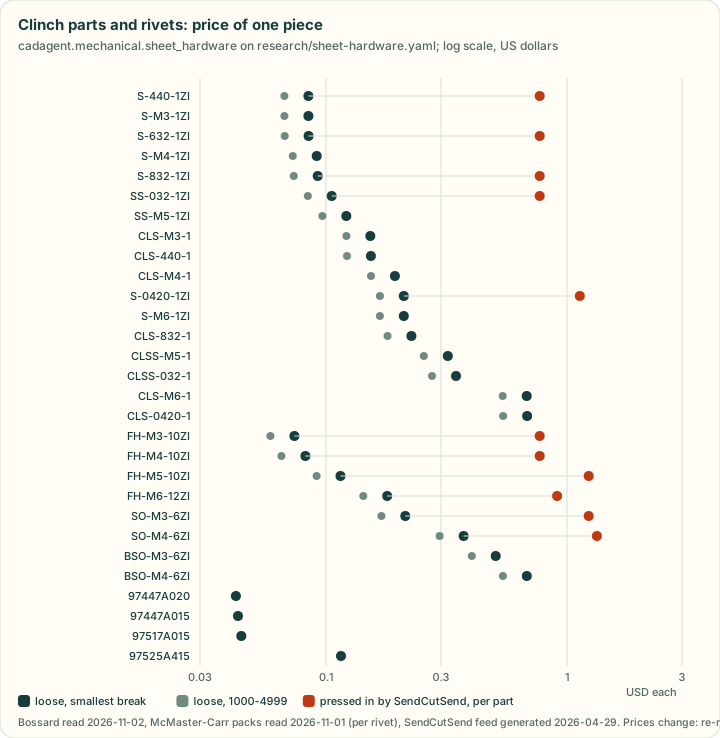
Drawn by tools/process_figures.py from cadagent.mechanical.sheet_hardware on research/sheet-hardware.yaml. A test
redraws it and fails if the committed chart differs. The prices are as read on the dates in the footer.
The pattern, step by step
Drawing diagram…
Scroll sideways to see the full diagram →
Diagram source
flowchart TD
    B["bends<br/>check_bends"] --> H["holes near bends<br/>feature_to_bend"]
    H --> C["clinch parts<br/>choose_clinch"]
    C --> P["place each<br/>check_placement"]
    P --> R["rivet seams<br/>choose_rivet"]
    R --> J["each seam<br/>check_joint"]
    J --> S["price<br/>cost"]
    classDef here fill:#fffdf5,stroke:#173d3c,color:#173d3c
    classDef out fill:#ffe1cc,stroke:#bd3a12,color:#173d3c
    class B,H,C,P,R,J here
    class S out
Each box is a function, and each one gives the next a number it needs: the bend allowance for the clinch part's
distance to the bend, and the stack for the rivet's grip. The sheet-metal-hardware skill
walks an agent through it.
from cadagent.manufacturing import sheet_metal as sm
from cadagent.mechanical import clinch, rivets, sheet_hardware as sh
sm.check_bends("5052", 1.6, [20, 20], relief_width_mm=1.6, hardware=True,   # flanges, relief, and the
               shop="sendcutsend")                    # shop's limits for a part with hardware
sh.choose_clinch("632", "5052-h32", 1.6)       # S-632-1 ($0.0847), then CLS-632-1 (no price read)
clinch.check_placement("S-632-1", "5052-h32", 1.6, edge_mm=6.5, to_bend_mm=8.0,
                       bend_allowance_mm=sm.bend("5052", 1.6)["allowance_mm"])
sh.choose_rivet(3.2, 3.0)                      # 1/8 in rivets for a 3.0 mm stack, cheapest first
rivets.check_joint("mcmaster-97447A015", [("5052-h32", 1.5), ("5052-h32", 1.5)], edge_mm=6.4, pitch_mm=25)
sh.cost({"S-632-1": 8, "mcmaster-97447A015": 24})   # $1.71 in pieces, $11.46 in packs; $6.16 to press the nuts in
The common, cheap choice
| For | Take | Each, loose | Pressed in by SendCutSend |
|---|---|---|---|
| A thread in 5052 or mild steel | zinc-plated steel S nut, M3–M5 or #4-40 to #10-32 | $0.08–0.12 | $0.77 (the inch sizes) |
| A stud | steel FH, M3–M6 | $0.07–0.18 | $0.77–1.23 |
| A board on a plate | steel SO or BSO standoff | $0.21–0.68 | $1.23–1.33 |
| A seam between two aluminium parts | 1/8 in aluminium rivet | $0.04 | not offered |
| Where it must not rust | stainless CLS or CLSS nut | $0.15–0.68 | not in the feed |
From research/sheet-hardware.yaml. Loose prices are Bossard Americas' prices for 1–249 pieces
([ref:bossard-pem-prices], read 2026-11-02). Rivet prices are McMaster-Carr's pack prices divided by the pack quantity
([ref:mcmaster-blind-rivets], read 2026-11-01). The pressed-in prices come from SendCutSend's ordering feed
([ref:sendcutsend-catalog]), which does not say whether its price includes the part.
So pressing a part in costs 7 to 11 times the loose part for the nuts and studs up to #10 and M5, and 3.6 to 5.8 times for the larger parts and the standoffs. A riveted seam costs a few cents per rivet. Stainless parts cost 1.8 to 3.3 times the steel ones, and none of the listed parts goes into stainless sheet.
Where to buy
Drawing diagram…
Scroll sideways to see the full diagram →
Diagram source
flowchart TD
    P["PEM parts<br/>Bossard"] --> X["you press<br/>them in"]
    S["SendCutSend<br/>sheet, pressed"] --> Y["you rivet<br/>the seams"]
    X --> Y
    R["rivets<br/>McMaster"] --> Y
    classDef here fill:#fffdf5,stroke:#173d3c,color:#173d3c
    classDef out fill:#ffe1cc,stroke:#bd3a12,color:#173d3c
    class P,S,R here
    class X,Y out
Where each part comes from. A sheet part the shop has pressed its clinch parts into needs only riveting; loose clinch parts from a distributor are pressed in first. Rivets come from a distributor.
- PEM parts: Bossard Americas sells them loose without an account, with stock counts on each part page. PEM sells through distributors, so other sellers have them too.
- Rivets: McMaster-Carr sells them in packs of 100 or 250. POP rivets, whose ratings the rivet check also uses, are sold through distributors. No POP prices are recorded yet.
- Pressed in: SendCutSend presses in 151 hardware parts from its feed, when you order the sheet part with
hardware. Check its own limits with the
shop="sendcutsend"checks.
Keeping it current
The data, the test that guards it, and how to refresh it
- The data: one item per orderable part number in
research/sheet-hardware.yaml. Each item carries its price, the day it was read, its seller's page, its source inresearch/references.yamland the part the checks know it as. - The test:
tests/mechanical/test_sheet_hardware.pyloads the catalogue and fails on a part the checks do not know, a price with no date, or a source that is not cited. - To refresh: re-read the part pages one at a time and update
price_usd,price_checkedandspecsfor each item. Then redraw the chart withpython3 tools/process_figures.py.
Limits. These are dated public prices before shipping and tax. Minimum orders and tooling (a press or a rivet gun)
are not counted. They are not quotes. A part the checks list without a price comes last, with offer empty. The
strengths behind the checks are the makers' test averages, not allowables, so test a sample part.